Start here
Is the fantasia show worth it?
What four hours in Temsia actually hold: the shuttle, the welcome, a long dinner with music at the tables, then the fantasia, and who should give it a miss.
Reserve the fantasia evening ↗Quick answer
Yes, for most visitors who want one evening that brings together Moroccan food, music and horsemanship. Expect about four hours door to door with the return shuttle from Agadir or Taghazout: a welcome with milk and dates, dinner under tents while musicians come to the tables, then an arena show in which fantasia riders charge and fire blanks. Drinks are extra, the volleys are loud, and the story is told through projections rather than English narration.
The short answer
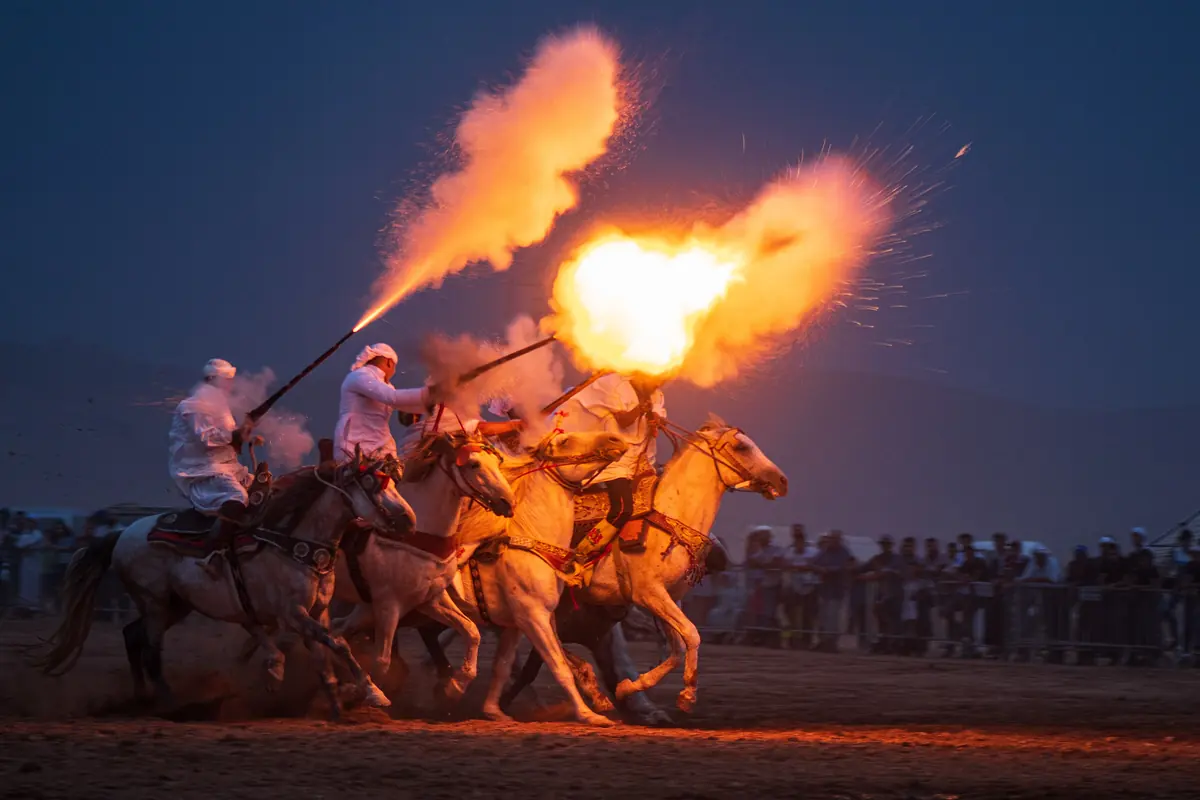
The fantasia evening near Agadir is worth booking if you treat it as what it is: a long, social night out that strings a Moroccan welcome, a big dinner, live folk music and a horse show into one ticket, with the transport handled for you. It is not a festival tbourida and not a polished theatre production, and the people who leave disappointed are mostly the ones who expected one of those. Go in expecting a full evening in which the horses are the finale rather than the main course, and the value is easy to see.
What happens in the four hours
The whole evening lasts about four hours, and that figure includes the drive out and back. Temsia lies south-east of Agadir on the Souss plain, a few minutes by road from the city's airport, so the ride from Taghazout, up the coast to the north-west, takes longer than the ride from central Agadir. Your confirmation gives the pickup point and time. In the busy summer months, traffic in Agadir can push pickups late, which is worth knowing before you plan an early start the next morning.
- A shuttle collects you in Agadir or Taghazout and drives you to Temsia.
- You are welcomed with milk and dates, to drums and folk songs.
- Tafarnout bread with amlou, honey and olive oil waits before you sit down.
- Dinner is served under large tents, with musicians coming to the tables.
- Everyone moves to the arena for the show, then the shuttle takes you back.
The welcome and the dinner
The evening opens the way Moroccan custom greets a guest, with milk and dates, to the sound of drums. Before you take your table there is Tafarnout, the bread of the Souss baked in a clay oven, to tear and dip in amlou, honey and olive oil. Amlou is a paste of toasted almonds, honey and argan oil, and it is worth tasting even if you skip everything else. Dinner itself is a set Moroccan meal served under caïdal tents and finished with mint tea and pastries. Recent guests describe the portions as huge. A vegetarian menu exists, but it has to be chosen when you book.
Music at the tables
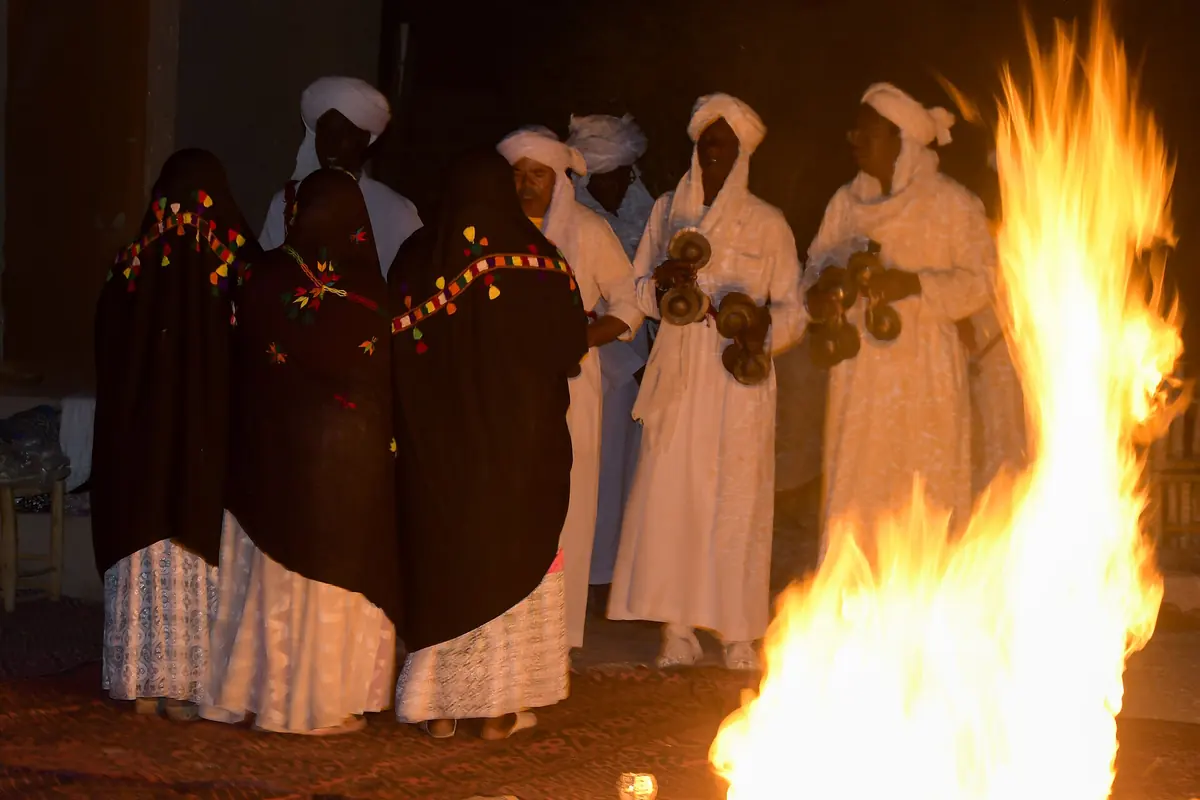
Between courses the musicians come to you rather than the other way round. Gnawa players, with their heavy iron castanets and the deep three-string guembri, work their way between the tables, followed by Dekka Marrakchia drummers and other folk troupes; the rwayess, the Amazigh poet-musicians of the Souss, are part of the line-up the ticket describes. Guests are sometimes pulled up to dance, and one recent visitor described a conga line forming to the percussion. Joining in is optional, but the evening rewards the people who say yes.
The arena show
After dinner the audience moves to the arena for the main show. When the lights go down, a storyteller character sets off on a quest through Morocco's landscapes and legends, and the performers appear as stages of that journey: fantasia horsemen, folk artists, a belly dancer, acrobats and fire-eaters. Projection mapping turns the arena into changing scenes, and music and light carry the story to a grand finale. The horses are the moment most people remember. The show is built for a mixed audience of all ages and many languages, so it leans on spectacle rather than dialogue.
About the gunfire
The fantasia is a cavalry charge, and a charge ends with the riders firing together. In tbourida, the Moroccan form of the fantasia, riders gallop in line and discharge blank rifles at the same instant, aiming for a single report. It is loud, sudden and close to the stands, and it is meant to be. For most visitors it is the thrill of the night. For small children who hate bangs, for anyone with noise sensitivity, and for anyone who finds gunfire distressing, it can spoil the evening. Ear defenders for young children are a sensible precaution.
Projections, not narration
Do not book expecting a play with spoken English. The storyteller's journey is carried by projection mapping, music and light, and the hosts greet guests in Arabic, English, French and Spanish rather than narrating the show line by line. One visitor this autumn advised making sure you can see the arena's back wall, because words appear on it during the performance, and wished for English audio for people whose view was blocked. When you reach the arena, choose a seat with a clear line to that wall and the story is easy to follow.
Why some visitors find the show short
The arena show is the last part of a long evening, and it moves fast. Each act is a stage in the story rather than a long set of its own, so a single act can be over before you have settled in. That is the most common criticism in recent reviews: the acts were good and the horses impressive, but some people wanted more of them, and more of the fire show in particular. If the horses are your only reason for going, keep that in mind. If you count the welcome, the dinner and the music as part of the show, the four hours feel full.
Outdoors, drinks and the small print
Dinner is served mainly in the open air under tents. In the cooler months covered areas are used, and a light jacket is recommended for winter evenings. Drinks are not included and are sold à la carte at the venue. Babies under two go free if they do not need a seat of their own, and a birthday cake or an announcement can be arranged if you ask at least 24 hours ahead. The ticket is listed as wheelchair accessible. Free cancellation runs until 24 hours before the night, for bookings made through GetYourGuide, and you can hold a place now and pay nearer the date.
Who this isn't for
Skip it if loud bangs upset you or your children, if you want a quiet dinner for two, or if you are looking for a long theatre show with dialogue you can follow. Nor will it please anyone who hates being drawn into dancing, though you can always decline. Purists who want tbourida as Moroccan troupes ride it, in competitions at a moussem, will find a staged sampler here and would do better to look for a regional festival. Everyone else, from families with older children to groups of friends, is the audience it was built for.
Booking it well
Book through the calendar on this site's home page, choose the vegetarian menu at that point if you need it, and note your pickup time from the confirmation. Pick a night early in your stay, because the shuttle and the late finish make it awkward to fit around an early flight. Pair it with daytime Agadir rather than another evening out: the city tour of the kasbah, the souk and the marina, or a quad-bike afternoon in the dunes, sits easily in the same day.
Read next: Fantasia night or city by day?
Frequently asked questions
How long does the fantasia evening last?
About four hours, including the return shuttle from Agadir or Taghazout. Pickup times are on your confirmation and can run late in summer traffic.
Is the gunfire very loud?
Yes. The riders fire blank rifles together at the end of the charge, close to the audience. Bring ear defenders for small children, and skip the evening if gunfire distresses you.
Is there English narration?
Not as a spoken commentary. The story is told with projection mapping, music and light, with words on the arena's back wall, so sit where you can see it.
Are drinks included?
No. Dinner, mint tea and pastries are included; drinks are bought separately at the venue.
Can vegetarians eat well?
Yes, if you choose the vegetarian menu when you book. It cannot be requested on the night, and it keeps the same dessert and mint tea.
What should I wear in winter?
Dinner is mostly outdoors under tents, with covered areas in the cooler months. A light jacket is recommended for winter evenings.
Sources