Tradition
Tbourida: the charge explained
Where the fantasia comes from, the two phases of a tbourida, why the volley must sound as one shot, and how to watch the charge when you see it in the arena.
Reserve the fantasia evening ↗From cavalry to celebration
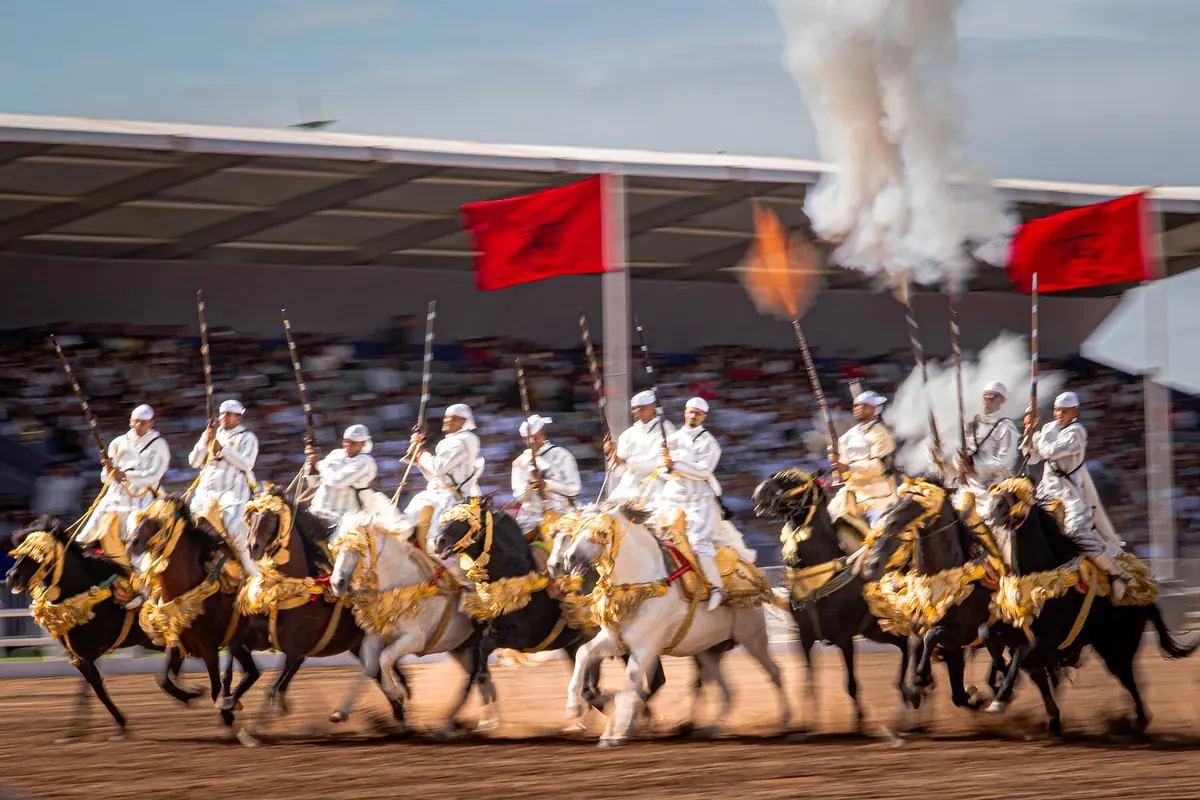
The fantasia is an equestrian display found across the Maghreb, performed at festivals and weddings from Morocco to Libya. Wikipedia traces it to the cavalry of ancient Numidia and describes it as both a cultural performance and a form of martial art. In Morocco, where it is called tbourida, UNESCO dates the tradition to the sixteenth century and describes it as a simulation of military parades that follows ancestral Arab-Amazigh conventions. UNESCO recognised it as intangible cultural heritage in 2021.
Why it is called tbourida
Tbourida comes from the word for gunpowder, and across the region the display is also called the gunpowder game or the horse game; in Tamazight it is tafrawt. Fantasia, the name most visitors know, is the one French Orientalists used, and painters such as Eugène Delacroix and Théo van Rysselberghe made the charge a favourite subject. The straight track the riders gallop along is the mahrak, and a troupe is led by a muqaddam, usually its most experienced rider, who rides at the centre of the line.
Two phases: salute and charge
UNESCO describes each tbourida in two parts. First comes the hadda, or salute: the riders enter the course at a trot and perform an acrobatic drill with their rifles, then return to the starting point. Then comes the talqa. The troupe sets off again at a gallop, the horses accelerating side by side, and at the end of the run the riders fire a round of blanks together, recalling a cavalry setting off for war. Riders often pray together before they mount, and many give the display a spiritual meaning.
The single shot
The hardest thing in tbourida is not speed but unison. The horses must stay level as they accelerate, and the riders must fire at the same instant so that the crowd hears one report rather than a ragged string of shots. The leader in the centre of the line sets the moment. Success is measured by that single detonation, and a scattered volley spoils even a fast charge. That is the thing to listen for when the riders reach the end of the arena: one clean crack, then smoke.
Horses, robes and rifles
The horses are Arabian, Barb or a mix of the two. The Barb is the North African breed long tied to the Amazigh peoples of the Maghreb, prized for hardiness and stamina. UNESCO notes that riders wear period costume, with a turban, draped robes and slippers, and carry a small Koran and an old Arab sword. Saddles and bridles are sewn and decorated by hand, and the costumes signal a rider's tribe or region. The long guns are muzzle-loaders, packed with black powder and fired without shot.
A living competition
Tbourida is not a museum piece. Wikipedia counts about a thousand registered troupes in Morocco, and each year hundreds compete for the Hassan II National Tbourida Trophy at El Jadida. Most displays take place at moussems, the regional festivals held in honour of saints, and at national holidays and agricultural fairs. Women ride too. Since 2003 a public body, the Royal Horse Promotion Society, known as SOREC, has worked to promote and preserve the practice.
Watching it in the arena
What you see at a dinner show is a staged version: a charge set inside a larger performance, rather than a competition between troupes on a long track. The essentials are the same. Watch the riders line up, follow the leader in the middle, and wait for the volley at the end of the run. It is loud and it comes quickly, so warn children before it happens. If you want to see tbourida as Moroccans compete in it, look for a regional moussem while you are in Morocco.
Sources